
📍 Where to find it: This feature can be accessed from the new Intelligence tab, which also includes the AI Visibility Index.
Please note that the AI Readiness Score is a premium feature and might not be included in your subscription. Contact your Customer Success Manager or support@localistico.com to activate this feature.
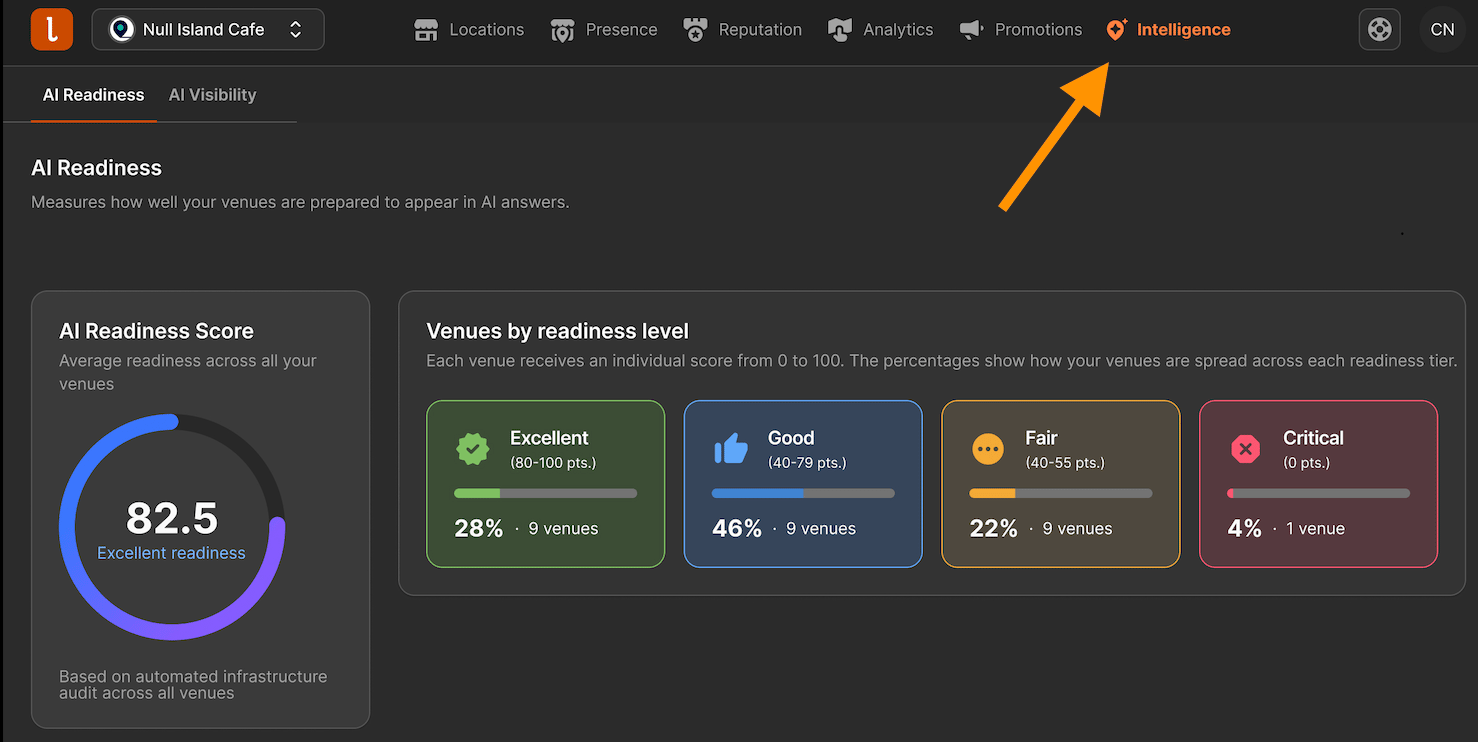
AI models like ChatGPT, Gemini, and Perplexity don't invent their recommendations. When a user asks "What's the best Italian restaurant near me?", the AI searches and validates information from multiple sources: Google Business profiles, structured data on websites, reviews across platforms and directories throughout the digital ecosystem.
If your online information is incomplete, inconsistent, or inaccessible to AI systems, two things happen: the AI could ignore you, or it could say incorrect things about you.
Readiness vs. Visibility: What’s the difference?
Unlike the AI Visibility Index—which requires running live, real-time queries against models like ChatGPT, Gemini, and Claude—the Readiness Score is calculated using publicly available and accessible data. Our system performs deep audits via web scraping, robots.txt verification, Google Business API queries, directory audits, and review analysis on open platforms.
The "Why" behind the "What": The Visibility Index tells you if you are being seen, but the Readiness Score tells you why. If your AI Visibility is low, the Readiness Score provides the specific diagnostic data needed to identify exactly what to fix (e.g., a broken Schema or a blocked crawler).
It’s helpful to think of these two metrics as the "Work" and the "Result":
-
AI Visibility Index (The Output): Measures how often the AI mentions you in its answers.
-
AI Readiness Score (The Input): Measures the preconditions. It evaluates whether your foundation is solid enough for the AI to trust your data in the first place.
How does it work
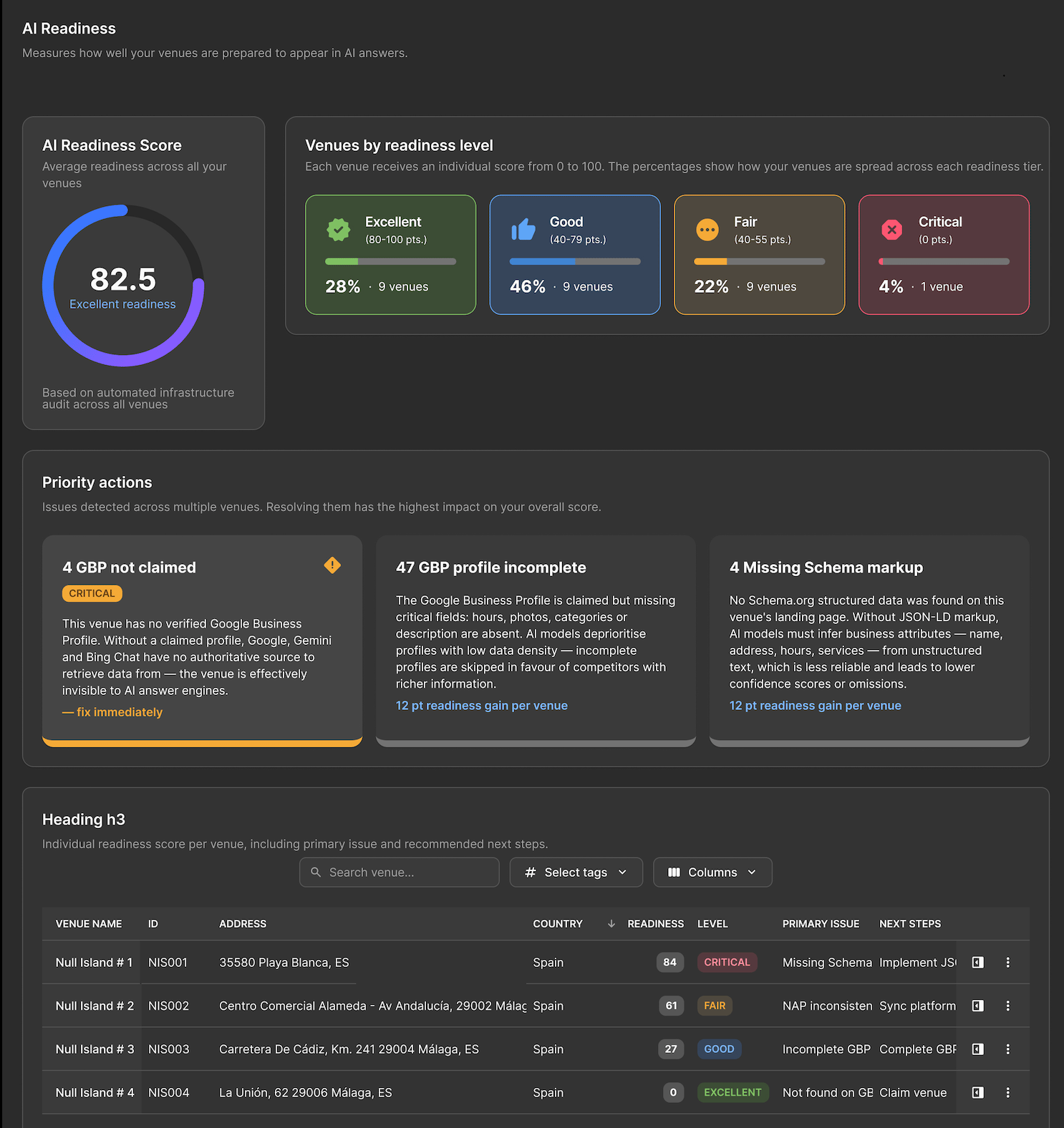
The 8 Vectors of AI Readiness
Our score evaluates eight specific "vectors"—signals that AI models use to discover and prioritise local businesses. These are weighted based on current AI research and industry data.
| Vector | Weight | Focus |
| 1. Knowledge Panel / Google Business Profile | High | Completeness of your Google Business Profile (name, address, phone, hours, categories, attributes, photos, description, and services). |
| 2. Semantic Schema | Med-High |
Whether your website implements JSON-LD markup (Schema.org - Schema.org ) correctly and completely. |
| 3. NAP Consistency | Med-High | Ensuring Name, Address, and Phone (NAP) are identical across all platforms (website, Google, Apple Maps, Yelp, TripAdvisor, local directories, social media, etc.). |
| 4. Sentiment Corpus | Med-High | The volume, quality, recency, and diversity of your reviews across multiple platforms (Google, Yelp, TripAdvisor, Facebook, industry-specific platforms). |
| 5. Citation Coverage | Medium | Your presence on Apple Maps, Yelp, Bing, and industry directories. |
| 6. Technical Accessibility | Medium | Ensuring AI crawlers (like GPTBot) aren't accidentally blocked by your site. |
| 7. Hyper-Local Content | Medium | Content that explicitly links your business to its neighborhood or landmarks. |
| 8. Brand Entity Strength | Low | How well the AI recognizes your brand name as a unique entity. |
Why these metrics matter
Unlike traditional search engines that look for specific words, AI looks for Entity Resolution. If your website says one thing, but Yelp says another, and your Google Profile is empty, the AI loses "confidence." When confidence is low, the AI moves on to a competitor with more consistent data. By optimising these eight vectors, you aren't just doing "SEO"—you are building a Source of Truth that AI models can rely on.
How to read the Score
The score provides a roadmap for improvement. Here is how to interpret the results:
-
🟢 80–100 (Excellent): Your infrastructure is optimised. You are a "preferred source" for AI.
-
🟡 60–79 (Good): You have a solid foundation but specific gaps (like missing Schema or inconsistent NAP) are holding you back.
-
🟠 40–59 (Fair): Significant friction exists. The AI likely struggles to verify your information.
-
🔴 0–39 (Critical): Foundational work is required. You are at high risk of being ignored or misrepresented by AI.
Important Considerations
It is a readiness index that evaluates, as objectively as possible, whether your digital infrastructure is aligned with the known mechanisms by which LLMs discover and process information about local businesses.
-
It does not guarantee visibility. A high Readiness Score means the preconditions are optimised, but actual visibility (measured by the AI Visibility Index) also depends on external factors: competition, the model's algorithmic decisions, training data, and platform evolution.
-
It is not an exact science. Some vectors (like Schema or GBP) can be evaluated with high objective precision. Others (like brand strength or hyper-local content) have a qualitative component. We calibrate weights to reflect relative importance according to available evidence, but these weights may evolve.
-
It is not permanent. The way LLMs process information changes with every model update. What carries high weight today could shift if AI models begin to rely more on other sources. We are committed to reviewing and updating the methodology as the ecosystem evolves.
-
It is not a perfect correlation with the Visibility Index. A business with a high Readiness Score and a low Visibility Index indicates that the infrastructure is solid but external factors (competition, niche, etc.) are limiting visibility. The relationship between both scores is informative, not deterministic.